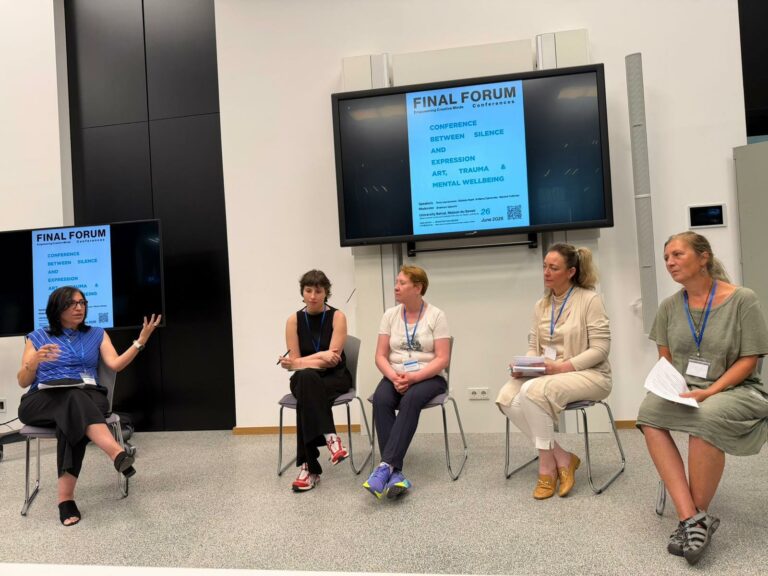
(Local Piloting workshops in Poland)
On 16–17 May 2026, the Community Garden in Bratnik became a meeting place for people from Poland, Ukraine and Belarus, who came together to explore movement, art and connection with nature. The workshops, led by Agnieszka Sikorska and Alesia Seraya, were organised as part of the Empowering Creative Minds project, funded through the Creative Europe programme. A total of 26 participants took part in the two events.
Local Empowering Creative Minds Workshops in the Community Garden in Bratnik
How can we speak about experiences that often escape words? How can we create a safe space for reflection on trauma, migration, loss, change and the rebuilding of a sense of stability? The Empowering Creative Minds project seeks answers precisely where language alone is not enough: in art, movement, bodily awareness and shared creative experiences.
The pilot workshops in Bratnik formed part of an international process aimed at supporting artists working with the theme of trauma and fostering meaningful creative dialogue within communities. The project is based on the idea that art can become not only a tool for expression, but also a way of reconnecting—with one’s own experience, with others and with the wider community. Rather than focusing solely on narratives of pain, it seeks forms that help people regain agency, cultivate self-compassion and strengthen a sense of belonging.
The Workshop as a Safe Space
The programme combined somatic practices, movement inspired by body-based methods, eco-somatic exercises, drawing, dance film viewing and conversation. Participants were not invited to evaluate their skills or strive for a “correct” performance of tasks. What mattered most was the experience itself: breathing, sensing body weight, rhythm, balance, connection with others, awareness of space and the opportunity to express whatever emerged from within.
The first part of the workshop focused on movement. The facilitators guided participants through a warm-up inspired by TRE (Tension and Trauma Releasing Exercises), pulse-awareness work, balance exercises, partner practices involving touch and weight-sharing, and activities connected to the surrounding environment of the Community Garden. Trees, soil, sounds and textures became active elements of the process. Nature was not merely a backdrop but an essential part of the work, helping participants ground themselves, slow down and experience support arising from both place and community.
In trauma-informed practice, a sense of safety is particularly important. For this reason, the workshop was designed as a gentle, open and non-directive space. Participants were encouraged to observe their own boundaries, choose their level of engagement and find forms of expression that felt accessible in the moment. The shared practice was rooted in listening—to the body, the breath, one’s partner, the group and the surrounding environment.
The Film Leaving Can’t Stay
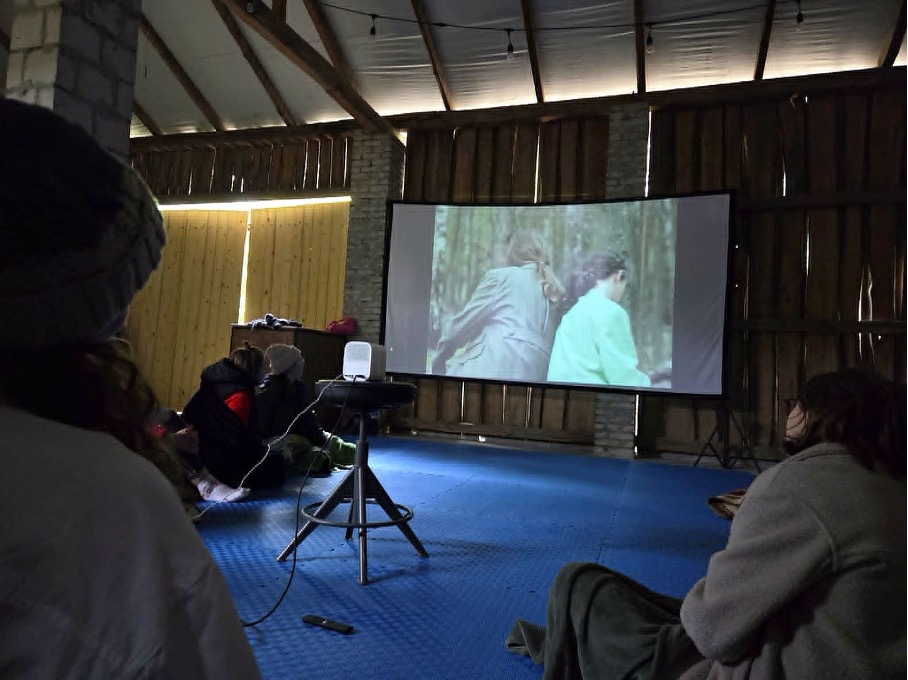
The central point of the event was a screening of the dance film Leaving Can’t Stay, created within the Empowering Creative Minds project. The film is a somatic contemporary dance piece developed by a Polish–Belarusian creative team. The concept was created by Agnieszka Sikorska in collaboration with Alesia Seraya. Cinematography and editing were by Kacper Pęczuła, while the original music was composed by Maciej Stępniewski.
The film emerged from a multilayered research process that included conversations with artists working with trauma, assessments of the needs of vulnerable creative practitioners and co-creation events organised in partner countries. Its artistic language brings together somatic practices, personal memories, experiences of migration and work with movement, voice, touch, rhythm and silence.
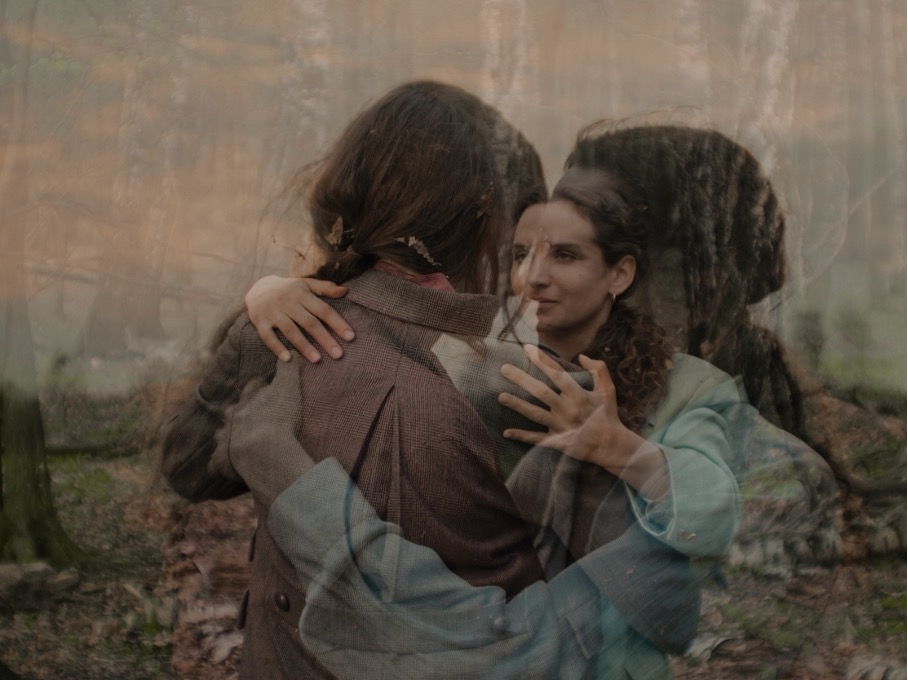
Leaving Can’t Stay tells a story of transition—the moment when one has left a familiar place but has not yet arrived at the next. It explores migration in a broad sense, not only as crossing national borders but also as an inner shift, the loss of a former point of stability and the search for a new one. The film does not reduce people to their trauma. Instead, it looks for the place from which movement can begin again: a small point of balance, a relationship, a gesture, a breath or the presence of another person.
From Watching to Co-Creating
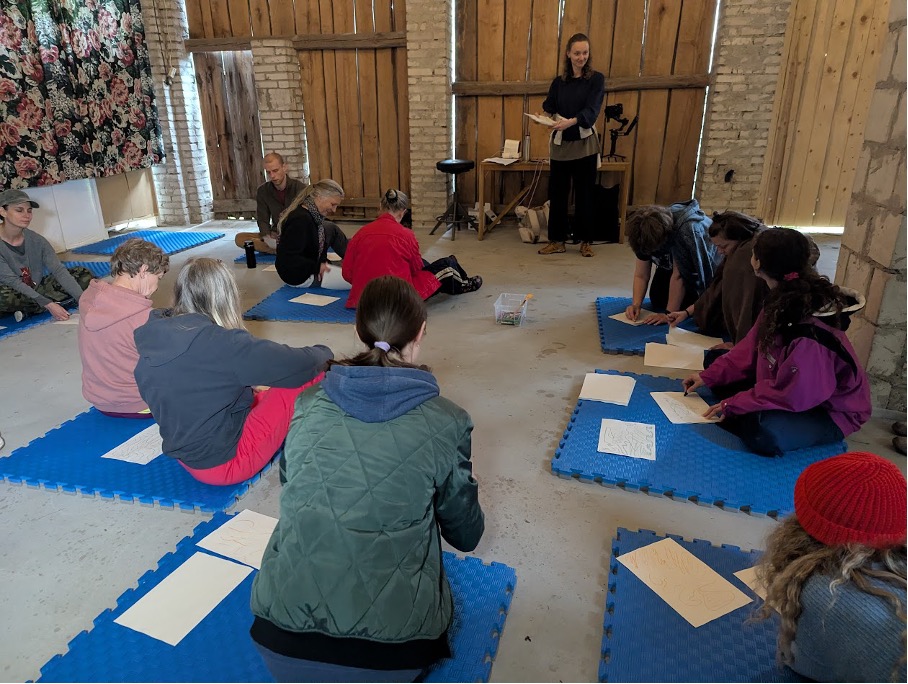
After the screening, participants did not immediately move into discussion. Instead, they were first invited to engage in intuitive drawing, stream-of-consciousness writing, finding a movement that remained in the body after watching the film, and taking a short solitary walk in silence. They could also bring back a leaf, stone, branch or another object from the surrounding environment if it helped express emotions and associations evoked by the film.
Only after this stage did conversations in pairs and collective reflection begin. This sequence was important because it reduced the pressure to immediately verbalise experiences. It allowed the artistic encounter to be processed through the body, image and gesture before being translated into words.
The workshop concluded with a practice called Leaving Trace—the creation of a shared space of traces. Participants could contribute drawings, written words, titles, gestures, movements or objects found in nature. What emerged was a symbolic record of the gathering: not an exhibition in the traditional sense, but a collective and temporary monument to shared experience, built from whatever each participant wished to leave behind within the group.
Between Poland, Ukraine and Belarus
People from Poland, Ukraine and Belarus took part in the workshops. This international and migration-related context was particularly important for the project. Experiences of leaving home, living between languages and cultures, rebuilding safety and seeking community in a new environment are not always easy to articulate. Art and body-based practices can open another pathway for dialogue—one that does not require immediate disclosure, but allows people to be together with attentiveness and respect.
For many years, the Community Garden in Bratnik has served as a place for gatherings, education and community action. During these workshops, it also became a space for working with memory, tension, loss and the rebuilding of relationships. Being in nature helped move the subject of trauma from an abstract conversation to a lived experience: How do I stand? How do I breathe? Where do I feel weight? Whom can I trust? How can I lean on the earth, a tree, another person or the group?
Empowering Creative Minds – Art as a Tool for Reflection
Empowering Creative Minds is a two-year initiative implemented through the Creative Europe programme by partners from Germany, Poland, Luxembourg and Ukraine: Comparative Research Network, the “Dla Ziemi” Association, DOURI and Unaedi. The project supports artists in addressing trauma through artistic practice while demonstrating that conversations about difficult experiences can be conducted in thoughtful, ethical and community-oriented ways.
Local pilot projects are an important stage of the ECM process. They bring tools developed through research, dialogue and international co-creation events directly into communities. In this way, art does not remain confined to institutions or professional artistic language. Instead, it becomes an invitation to participate—open to people with different experiences, languages, abilities and levels of readiness to share their stories.
The workshops in Bratnik demonstrated that community-based work with trauma does not have to begin with telling personal stories directly. It can start with the movement of a hand, a shared pulse, a breath, silence, a walk or a drawing made without lifting the pencil from the paper. It can begin with the simple experience of recognising that we are not alone—that safety sometimes needs to be rebuilt from the ground up, but that it can be built together.
On 16–17 May 2026, the Community Garden in Bratnik became a meeting place for people from Poland, Ukraine and Belarus, who came together to explore movement, art and connection with nature. The workshops, led by Agnieszka Sikorska and Alesia Seraya, were organised as part of the Empowering Creative Minds project, funded through the Creative Europe programme. A total of 26 participants took part in the two events.
Local Empowering Creative Minds Workshops in the Community Garden in Bratnik
How can we speak about experiences that often escape words? How can we create a safe space for reflection on trauma, migration, loss, change and the rebuilding of a sense of stability? The Empowering Creative Minds project seeks answers precisely where language alone is not enough: in art, movement, bodily awareness and shared creative experiences.
The pilot workshops in Bratnik formed part of an international process aimed at supporting artists working with the theme of trauma and fostering meaningful creative dialogue within communities. The project is based on the idea that art can become not only a tool for expression, but also a way of reconnecting—with one’s own experience, with others and with the wider community. Rather than focusing solely on narratives of pain, it seeks forms that help people regain agency, cultivate self-compassion and strengthen a sense of belonging.
The Workshop as a Safe Space
The programme combined somatic practices, movement inspired by body-based methods, eco-somatic exercises, drawing, dance film viewing and conversation. Participants were not invited to evaluate their skills or strive for a “correct” performance of tasks. What mattered most was the experience itself: breathing, sensing body weight, rhythm, balance, connection with others, awareness of space and the opportunity to express whatever emerged from within.
The first part of the workshop focused on movement. The facilitators guided participants through a warm-up inspired by TRE (Tension and Trauma Releasing Exercises), pulse-awareness work, balance exercises, partner practices involving touch and weight-sharing, and activities connected to the surrounding environment of the Community Garden. Trees, soil, sounds and textures became active elements of the process. Nature was not merely a backdrop but an essential part of the work, helping participants ground themselves, slow down and experience support arising from both place and community.
In trauma-informed practice, a sense of safety is particularly important. For this reason, the workshop was designed as a gentle, open and non-directive space. Participants were encouraged to observe their own boundaries, choose their level of engagement and find forms of expression that felt accessible in the moment. The shared practice was rooted in listening—to the body, the breath, one’s partner, the group and the surrounding environment.
The Film Leaving Can’t Stay
The central point of the event was a screening of the dance film Leaving Can’t Stay, created within the Empowering Creative Minds project. The film is a somatic contemporary dance piece developed by a Polish–Belarusian creative team. The concept was created by Agnieszka Sikorska in collaboration with Alesia Seraya. Cinematography and editing were by Kacper Pęczuła, while the original music was composed by Maciej Stępniewski.
The film emerged from a multilayered research process that included conversations with artists working with trauma, assessments of the needs of vulnerable creative practitioners and co-creation events organised in partner countries. Its artistic language brings together somatic practices, personal memories, experiences of migration and work with movement, voice, touch, rhythm and silence.
Leaving Can’t Stay tells a story of transition—the moment when one has left a familiar place but has not yet arrived at the next. It explores migration in a broad sense, not only as crossing national borders but also as an inner shift, the loss of a former point of stability and the search for a new one. The film does not reduce people to their trauma. Instead, it looks for the place from which movement can begin again: a small point of balance, a relationship, a gesture, a breath or the presence of another person.
From Watching to Co-Creating
After the screening, participants did not immediately move into discussion. Instead, they were first invited to engage in intuitive drawing, stream-of-consciousness writing, finding a movement that remained in the body after watching the film, and taking a short solitary walk in silence. They could also bring back a leaf, stone, branch or another object from the surrounding environment if it helped express emotions and associations evoked by the film.
Only after this stage did conversations in pairs and collective reflection begin. This sequence was important because it reduced the pressure to immediately verbalise experiences. It allowed the artistic encounter to be processed through the body, image and gesture before being translated into words.
The workshop concluded with a practice called Leaving Trace—the creation of a shared space of traces. Participants could contribute drawings, written words, titles, gestures, movements or objects found in nature. What emerged was a symbolic record of the gathering: not an exhibition in the traditional sense, but a collective and temporary monument to shared experience, built from whatever each participant wished to leave behind within the group.
Between Poland, Ukraine and Belarus
People from Poland, Ukraine and Belarus took part in the workshops. This international and migration-related context was particularly important for the project. Experiences of leaving home, living between languages and cultures, rebuilding safety and seeking community in a new environment are not always easy to articulate. Art and body-based practices can open another pathway for dialogue—one that does not require immediate disclosure, but allows people to be together with attentiveness and respect.
For many years, the Community Garden in Bratnik has served as a place for gatherings, education and community action. During these workshops, it also became a space for working with memory, tension, loss and the rebuilding of relationships. Being in nature helped move the subject of trauma from an abstract conversation to a lived experience: How do I stand? How do I breathe? Where do I feel weight? Whom can I trust? How can I lean on the earth, a tree, another person or the group?
Empowering Creative Minds – Art as a Tool for Reflection
Empowering Creative Minds is a two-year initiative implemented through the Creative Europe programme by partners from Germany, Poland, Luxembourg and Ukraine: Comparative Research Network, the “Dla Ziemi” Association, DOURI and Unaedi. The project supports artists in addressing trauma through artistic practice while demonstrating that conversations about difficult experiences can be conducted in thoughtful, ethical and community-oriented ways.
Local pilot projects are an important stage of the ECM process. They bring tools developed through research, dialogue and international co-creation events directly into communities. In this way, art does not remain confined to institutions or professional artistic language. Instead, it becomes an invitation to participate—open to people with different experiences, languages, abilities and levels of readiness to share their stories.
The workshops in Bratnik demonstrated that community-based work with trauma does not have to begin with telling personal stories directly. It can start with the movement of a hand, a shared pulse, a breath, silence, a walk or a drawing made without lifting the pencil from the paper. It can begin with the simple experience of recognising that we are not alone—that safety sometimes needs to be rebuilt from the ground up, but that it can be built together.
Autor/źródło: https://dlaziemi.org